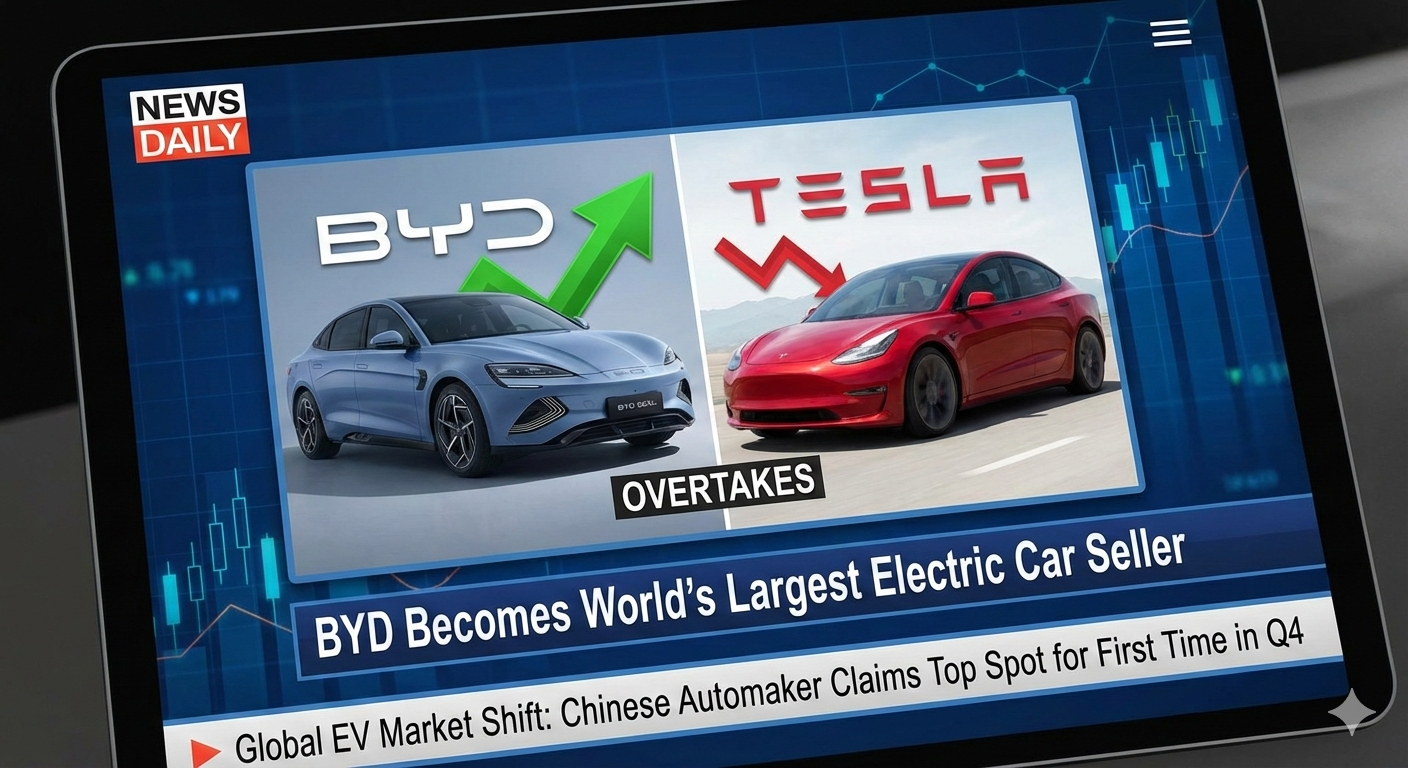
China’s BYD moves past Tesla in electric car sales, signalling a deeper shift in how electric mobility scales worldwide
China’s BYD has overtaken Tesla to become the world’s largest electric car seller. While the headline centres on volumes, the change matters because it alters how electric mobility is produced, priced, and absorbed by markets at scale.
At this moment, electric mobility is no longer defined by early adopters or premium positioning. Instead, it is being shaped by who can deliver reliability, affordability, and speed across millions of vehicles and across very different operating conditions.
The timing behind BYD’s rise
BYD’s rise comes as electric mobility demand is broadening beyond North America and Europe. In China and emerging markets, buyers are prioritising cost control, charging compatibility, and service reach. As a result, scale now matters more than brand narrative.
Because BYD operates across batteries, vehicles, and components, electric mobility production has become more vertically integrated. This matters since it reduces exposure to global supply disruptions. It also stabilises pricing, even as raw material volatility continues elsewhere.
Also Read: Xiaomi EVs Set for Global Expansion, But only by 2027!
Scale as a mobility advantage
Electric mobility increasingly rewards manufacturers who treat vehicles as part of a wider system. BYD’s volumes allow it to standardise platforms across passenger cars, buses, and commercial fleets. Therefore, learning cycles shorten, and costs fall faster.
Tesla, by contrast, remains strong in software-led features and charging ecosystems. However, this at a mass scale now depends on manufacturing rhythm as much as innovation speed. As volumes grow, operational efficiency begins to shape adoption more than novelty.
Global implications beyond China
As BYD expands exports, markets in Southeast Asia, Latin America, and parts of Europe are seeing faster price compression. Consequently, fleet operators and city transport agencies are reassessing procurement timelines.
This shift matters because electric mobility in these regions often depends on total cost of ownership rather than incentives. When vehicles become cheaper and more predictable to maintain, adoption moves from policy ambition to operational decision.
Pressure on supply chains and infrastructure
Electric mobility systems rely heavily on batteries, charging hardware, and aftersales networks. With BYD producing its own batteries, supply chains are tightening around fewer but larger players. This changes bargaining power across the ecosystem.
At the same time, infrastructure planning must respond. More affordable electric mobility increases vehicle density on shared charging networks. Therefore, cities and highway operators face new stress points around grid capacity and charger uptime.
Competitive logic is shifting
The competition between BYD and Tesla is no longer just about vehicles. Instead, it reflects two models of electric mobility scaling. One prioritises integration and cost discipline, while the other emphasises software, autonomy, and brand pull.
As electric mobility matures, both models influence how quickly markets transition. However, volume-led strategies tend to reshape behaviour first, because they touch taxis, delivery fleets, and public transport earlier than private ownership trends.
Beyond the Spec Sheet
On roads and in fleets, this shift shows up quietly. Electric mobility becomes less aspirational and more routine. City buses run on fixed charging schedules, delivery vans optimise routes based on predictable ranges, and shared fleets cycle vehicles more quickly due to lower upfront costs.
In cities, electric mobility begins to blend into transport planning rather than stand apart. Parking norms adjust, depot charging expands, and grid upgrades follow demand instead of pilots. Behaviour changes as drivers treat electric vehicles as tools rather than statements.
Across logistics and urban transport, electric vehicles now function as infrastructure. BYD overtaking Tesla signals that the system is entering a phase where execution, not evangelism, determines who shapes daily movement.