
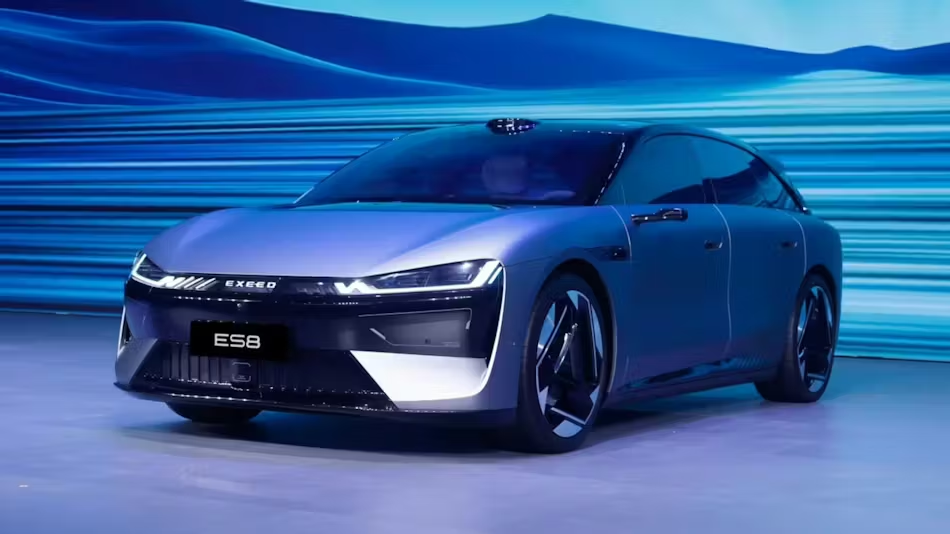
Chinese automaker Chery will road-test its in-house solid-state battery in premium Exeed models this year
Chery Automobile announced plans to test its self-developed solid-state battery in Exeed electric vehicles during 2026. The trials will involve premium models from the Exeed lineup. This move follows recent unveilings of updated SUVs and shooting brakes.
The development matters now because solid-state batteries address key limitations in current electric systems. They offer higher energy density than lithium-ion packs. Moreover, they enhance safety and charging speeds. For global markets, including India, this could accelerate adoption of long-range EVs.
Solid-State Battery Specifications
Chery developed the Chery Exeed solid-state battery module in-house. It achieves an energy density of 600 Wh/kg. This figure nearly doubles that of typical lithium-ion batteries at around 300 Wh/kg. As a result, vehicles equipped with it can reach up to 1000 km on a single charge.
The battery underwent rigorous tests. It survived nail penetration and power drill impacts without catching fire. Additionally, it maintained performance after extreme temperature cycles. These results confirm its reliability for real-world use. However, full production details remain pending.
Integration into Exeed EV Models
Chery will integrate the Chery Exeed solid-state battery into models like the ES8 SUV and ET9. The ES8, for instance, will feature this tech in its shooting brake variant. Testing starts mid-2026 on public roads. This approach allows data collection under varied conditions.
Exeed’s lineup targets premium buyers. The ES7 GT and ES8 already use advanced electric architectures. Now, the Chery Exeed solid-state battery will extend its range beyond 800 km in some configurations. Furthermore, it supports faster charging, adding 500 km in under 30 minutes.
Also Read: 10-Min Recharge and 1000 Cycles : New EV Battery Breakthrough, a Gamechanger
Supply Chain and Infrastructure Impacts
The Chery Exeed solid-state battery relies on domestic supply chains in China. Chery collaborates with its battery arm to scale production. This reduces import dependencies for key components. In turn, it lowers costs for manufacturers outside China.
For infrastructure, the battery demands upgrades in charging networks. High-voltage stations must handle its power output. Yet, existing grids in urban areas can adapt with minimal changes. Over time, this eases the strain on public chargers during peak hours.
Global Market Relevance
India’s electric vehicle market will feel indirect effects from the Chery Exeed solid-state battery tests. Local assemblers may license similar tech by 2028. This could cut import duties on battery packs. Besides, it promotes competition in the premium segment.
Chery’s focus on exports means models like the ES8 could enter Indian showrooms soon. Buyers gain access to safer, longer-lasting EVs. However, regulatory approvals for solid-state tech remain a hurdle. Data from 2026 trials will inform those processes.
Beyond the Spec Sheet
The solid-state battery enables seamless inter-city travel for daily commuters. Drivers cover 1000 km without range worries, reducing stops at stations. Goods transport sees lower downtime as fleets charge quicker, cutting fuel costs by half over diesel options.
Access improves in rural areas where charging points are sparse. Reliable batteries mean fewer disruptions in power supply chains. Urban behaviour shifts too, with owners opting for EVs over petrol cars due to stable energy output. Maintenance drops as solid-state packs last longer, easing ownership burdens.


