
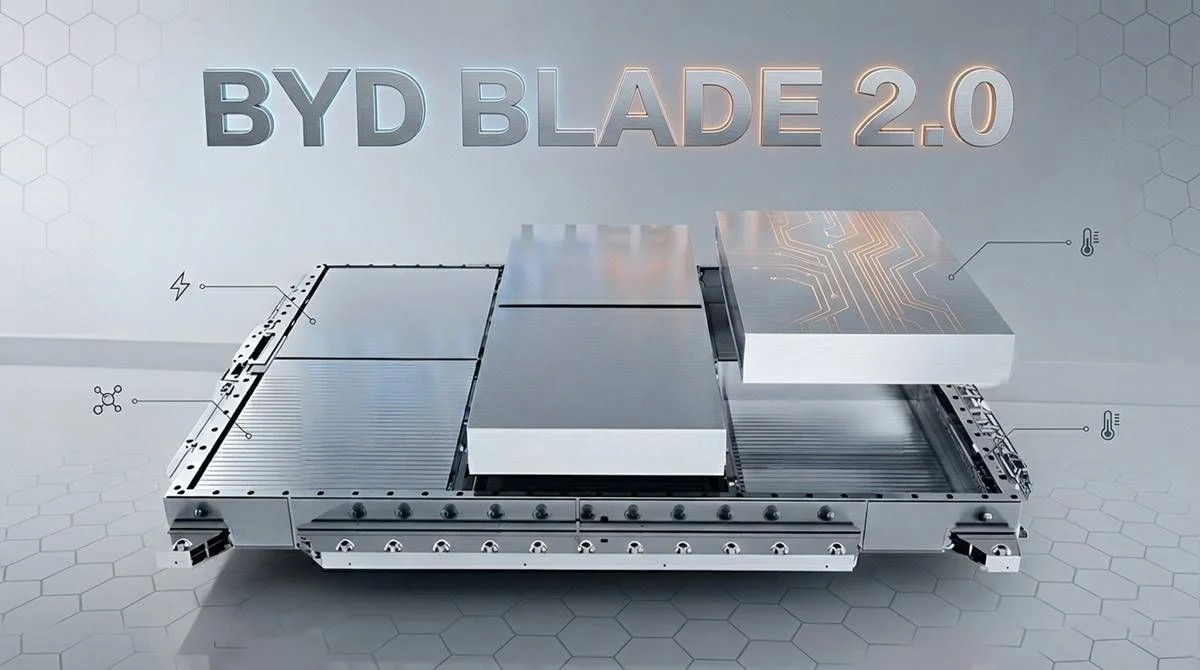
New Blade Battery achieves 10-70% charge in five minutes and 10-97% in nine minutes using FLASH Charging technology
BYD unveiled the second-generation Blade Battery in Shenzhen. The battery pairs with new FLASH Charging technology to deliver record charging speeds.
This matters now because it tackles key barriers in electric mobility. Slow charging and reduced performance in cold weather limit widespread adoption. The second-generation BYD Blade Battery addresses both issues directly.
Ultra-Fast Charging Capability
The second-generation BYD Blade Battery supports charging from 10% to 70% in about five minutes. It reaches 10% to 97% in nine minutes under optimal conditions. This uses proprietary FLASH Charging stations with up to 1500 kW power.
The battery maintains strong performance in low temperatures. At minus 30 degrees Celsius, it charges from 20% to 97% in around 12 minutes.
Also Read: 10-Min Recharge and 1000 Cycles : New EV Battery Breakthrough, a Gamechanger
Energy Density and Range Improvements
The second-generation BYD Blade Battery increases energy density by over 5% compared to the first generation. This enables ranges exceeding 1000 km under the CLTC cycle in compatible models.
The design retains LFP chemistry for safety and cost efficiency. It supports high charge rates up to 10C in some variants while keeping structural integrity.
Multiple BYD brands will receive the second-generation BYD Blade Battery soon. Models include Denza Z9GT, Yangwang U7, and others across segments.
Infrastructure Requirements
FLASH Charging demands high-power stations. BYD plans to expand its network to support this capability. Current stations exceed 4000, with a target of 20000 by end-2026.
Grid upgrades become necessary in high-traffic areas to handle peak loads from 1500 kW chargers.
Beyond the Spec Sheet
Drivers complete quick stops for long-distance travel. Inter-city movement becomes more practical with minimal downtime at charging points.
Goods transport fleets reduce idle time during recharges. Delivery schedules improve with predictable short breaks.
Cost per kilometre drops as frequent fast top-ups replace longer sessions. Reliability increases in varied climates, including cold regions.
Urban commuters gain confidence in daily electric use without extended waits. Behaviour shifts as charging aligns more closely with refuelling habits for petrol vehicles.


