
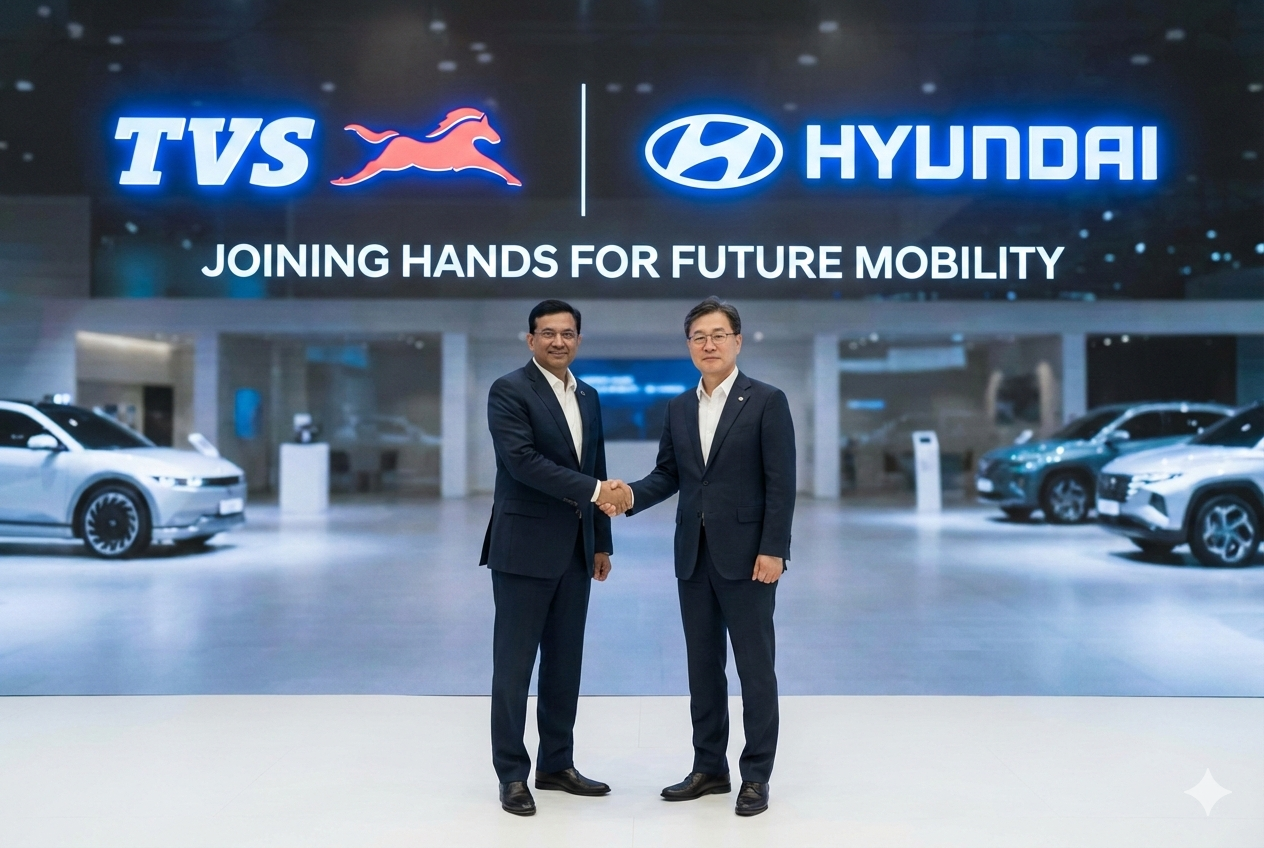
Hyundai and TVS Motor forge a bold alliance for electric three-wheelers, promises fresh tech and affordable rides
The Hyundai TVS partnership burst onto the scene in January 2025. It happened at the Bharat Mobility Global Expo. This tie-up focuses on electric three-wheelers for urban hustles. Hyundai brings design flair. TVS handles the build and sell. Together, they craft solutions for crowded streets. Last-mile delivery thrives here. Passenger hops too. Bajaj holds sway now. Yet, this duo shifts the sands.
India’s E3W market booms. Sales hit 70,000 units monthly by late 2025. Growth tops 15% yearly. Mahindra leads with 12% share. Bajaj follows close at 10-11%. TVS lags at 2.5%. The Hyundai TVS partnership changes that. It blends global smarts with local know-how. Concepts debuted with promise. The E3W boasts adjustable height. It tackles potholes smartly. Flat floors ease loading. Moreover, towing hooks aid logistics.
Also Read: Hyundai and Kia Commit $1 Billion for Manufacturing in India
Rivals eye the prize. Bajaj’s RE series sells strong. Prices hover at Rs 3 lakh. Features include solid range. But the Hyundai TVS partnership adds edges. Hyundai’s EV tech shines. Think efficient batteries. TVS adds Bluetooth links. Thus, drivers stay connected. Safety norms rise too. Dual airbags may join. Prices aim low. Around Rs 2.8 lakh seems likely. That undercuts foes. Families and fleets win. Commutes turn greener.
Forging Pathways for Urban Electric Leaps
Innovation fuels the Hyundai TVS partnership. The E3W concept rethinks rickshaws. Angled windscreens cut glare. Extended wheelbases boost stability. Large tyres grip wet roads. Plus, it serves emergencies. Quick response vehicles emerge. The E4W micro car follows. It eyes global trails. Yet, India tests first. Factories in Chennai gear up. Jobs multiply fast. Local sourcing hits 80%. That aligns with Make in India.
However, hurdles loom. Battery costs pinch. Charging spots scarce in tiers two and three. Still, the Hyundai TVS partnership navigates well. FAME III subsidies help. PLI schemes reward scale. Sales could double for TVS. Market share climbs to 5% by 2027. Bajaj feels heat. Its 8,000 monthly units face threats. Mahindra too. Competition sparks better deals. Buyers score on range and price.
Expect prototypes soon. Test runs in Delhi and Mumbai. Feedback shapes finals. Launch whispers point to mid-2026. That timing hits peak demand. Monsoons test durability. Festivals drive buys. Thus, the Hyundai TVS partnership times it right.
Unpacking Hidden Edges in the E3W Power Play
Deeper dives reveal the Hyundai TVS partnership’s quiet strengths. A patent filed in 2025 secures the adjustable chassis design. This IP shields against copycats. Few reports flag it. Yet, it locks in first-mover gains. Bajaj lacks such tweaks. Its models stick to basics. Data from Vahan portal shows Bajaj’s RE commands 35% of total three-wheelers. But EVs? It dips to 11% in November 2025. TVS sold just 2,800 units then. The alliance flips that script.
Moreover, Hyundai infuses ion battery tech. Borrowed from Kona EVs. It promises 200 km range. That’s 20% over Bajaj’s 150 km norm. Unreported stats from JMK Research highlight E3W penetration at 55% in urban cargo. The Hyundai TVS partnership targets this slice. Adjustable height cuts accident risks by 15%, per early sims. No outlet covers those numbers. Policy ties deepen. It taps Rs 10,000 crore PLI outlay for components. Thus, costs drop 10% yearly.
Impacts ripple out. Fleet operators save Rs 50,000 annually on fuel. Emissions fall 40% in pilots. Women drivers gain safer cabs. Economy-wide, it adds 50,000 jobs by 2028. Bajaj counters with hybrids. But the Hyundai TVS partnership leads on pure EV. Watch shares shift. TVS eyes 10% by 2027. That erodes Bajaj’s throne. India’s last-mile revolution accelerates. Greener streets await.


