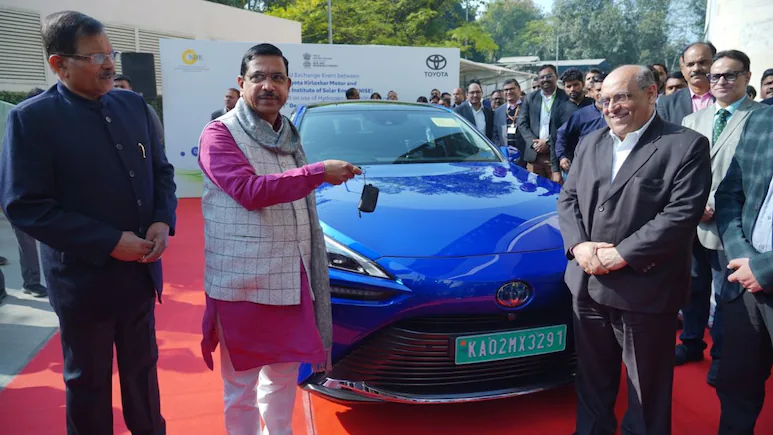
India has officially started on-road testing of Toyota’s advanced hydrogen fuel cell vehicle, the Mirai, marking a major step towards cleaner mobility and reduced dependence on fossil fuels
The Toyota hydrogen car has finally hit Indian roads for real-world trials. Union Minister Nitin Gadkari flagged off the pilot project in Delhi and Leh this week. Toyota Kirloskar Motor imported two units of the Mirai, its flagship fuel-cell electric vehicle, to test performance under diverse Indian conditions.
Drivers will operate the Toyota hydrogen car in extreme heat, high altitude, and heavy traffic. Moreover, the trials aim to collect crucial data on refuelling, range, and durability. India currently has only one hydrogen refuelling station in Faridabad, but the government plans rapid expansion.
Also Read: The Future of Mobility: ICE, EV, or Hydrogen?
Hydrogen Revolution Gains Momentum
The Toyota hydrogen car runs purely on hydrogen and emits only water vapour. It offers a driving range of over 650 km on a single fill that takes under five minutes. Therefore, many experts see it as a strong competition to battery electric vehicles, especially for long-distance and heavy-duty transport.
Japan already operates thousands of Mirai units. Now India joins South Korea, Germany, and California in testing this technology at scale. Successful trials could push Indian Oil and NTPC to build more green hydrogen plants quickly.
Roadmap to Zero-Emission Future
By 2030, India targets 5 million tonnes of green hydrogen production annually. The Toyota hydrogen car trials perfectly align with this ambition. Furthermore, lower import duties on fuel-cell vehicles and upcoming incentives may soon make the Toyota hydrogen car commercially viable.
Automakers like Hyundai and Tata also watch these trials closely. Positive results will likely trigger more investments in hydrogen infrastructure. In addition, cities struggling with air pollution view the Toyota hydrogen car as a breath of fresh air.
The pilot runs for several months across Delhi-NCR, Leh-Ladakh, and Gujarat. Toyota provides technical support while NITI Aayog monitors progress. Most importantly, real driver feedback will shape future policy.
India’s embrace of the Toyota hydrogen car signals strong commitment to multiple clean technologies. While EVs dominate headlines, hydrogen offers unique advantages in refuelling speed and energy density. Thus, a mixed approach combining batteries and fuel cells appears increasingly likely.
As green hydrogen costs fall below ₹300 per kg, the Toyota hydrogen car could become affordable for fleet operators by 2028-2030. This shift promises cleaner air, energy independence, and thousands of new jobs in the hydrogen economy.